
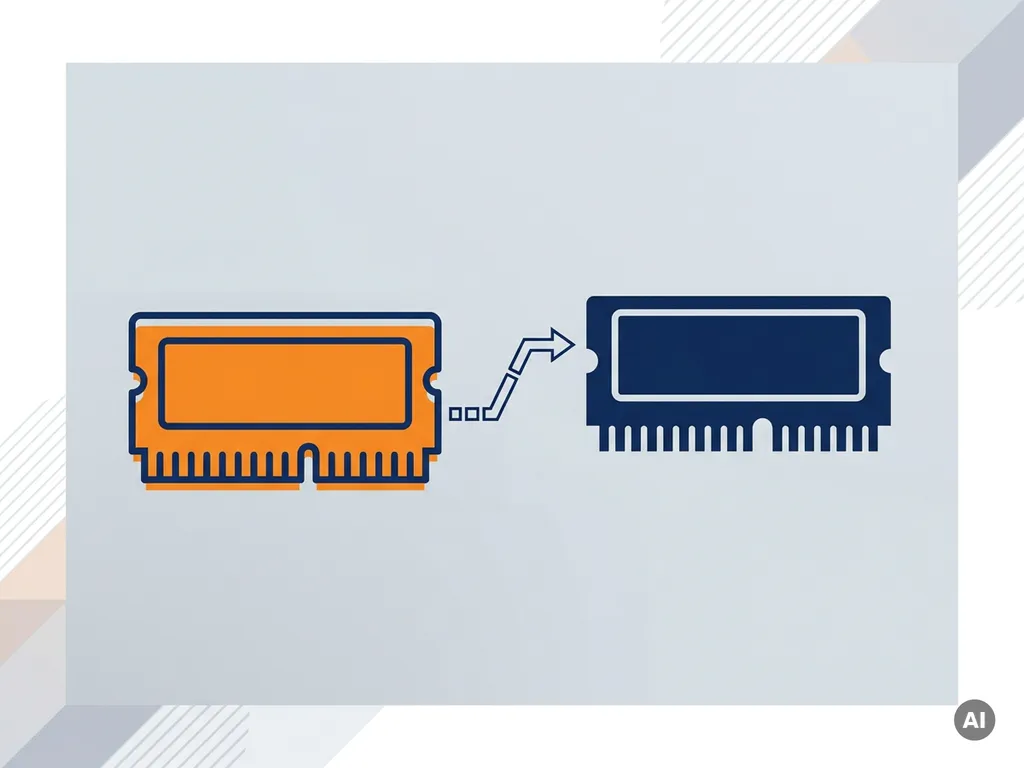
DDR5 server memory improves on DDR4 by delivering roughly double the bandwidth, higher data transfer speeds, and lower operating voltage. The practical impact depends on your workload: memory-intensive applications like virtualization, AI inference, and large databases benefit most. For general-purpose servers with moderate memory demands, DDR4 remains a cost-effective and widely supported choice. This article breaks down the key differences across speed, power, compatibility, and upgrade planning so you can make an informed decision.
How does DDR5 server memory actually improve on DDR4?
DDR5 improves on DDR4 by increasing memory channel density, raising base frequencies, and introducing on-die ECC (error correction) at the module level. Where DDR4 tops out at around 3200 MT/s in standard server configurations, DDR5 starts at 4800 MT/s and scales significantly higher. The result is more data moved per clock cycle and better support for the growing core counts found in modern server CPUs.
One structural change worth understanding is that DDR5 doubles the number of independent 32-bit subchannels per module, compared to DDR4’s single 64-bit channel per module. This improves parallel memory access and reduces latency under concurrent workloads. For servers running multiple virtual machines or containerized workloads, this architectural shift translates to measurably better throughput when memory is the bottleneck.
DDR5 also supports higher module capacities per DIMM slot, which matters for memory-dense server builds where physical slot count is limited.
What are the bandwidth and speed differences between DDR4 and DDR5?
DDR5 offers approximately twice the peak bandwidth of DDR4. Standard DDR4 server modules operate between 2133 MT/s and 3200 MT/s, delivering peak bandwidth of roughly 25 GB/s per channel. DDR5 starts at 4800 MT/s and scales to 6400 MT/s and beyond in current server-grade modules, pushing peak bandwidth well above 50 GB/s per channel.
In practice, the bandwidth advantage of DDR5 versus DDR4 is most visible in workloads that continuously stream large datasets through memory: scientific computing, real-time analytics, large language model inference, and high-throughput database queries. For workloads that are compute-bound rather than memory-bound, the difference between DDR4 and DDR5 server RAM is less pronounced in day-to-day operation.
It is also worth noting that DDR5 modules have slightly higher base latency (CAS latency) than DDR4 at equivalent timings. The raw bandwidth advantage more than compensates for this in most server scenarios, but latency-sensitive, low-concurrency workloads may see a smaller net gain.
Does DDR5 use less power than DDR4 in server environments?
Yes, DDR5 operates at a lower voltage than DDR4, which reduces power draw per module. DDR4 server memory runs at 1.2V, while DDR5 drops to 1.1V. In a server chassis populated with many DIMM slots, this difference adds up across the memory subsystem and contributes to lower overall power consumption and heat output.
DDR5 also moves the voltage regulator onto the module itself (on-module PMIC, or Power Management IC), rather than relying on the motherboard to regulate memory voltage. This improves power delivery precision, which can stabilize performance under heavy load and reduce thermal variance across slots.
For data centers where power and cooling costs are significant operational factors, the efficiency gains from DDR5 server RAM are a real consideration, particularly when scaling across many servers or planning new infrastructure builds in 2026 and beyond.
Are DDR4 and DDR5 server modules physically compatible?
No, DDR4 and DDR5 server modules are not physically compatible and cannot be used interchangeably. DDR5 DIMMs use a different keying notch position than DDR4, which means a DDR5 module will not fit into a DDR4 slot, and vice versa. Mixing generations in the same server is not possible.
Beyond the physical connector, DDR5 requires a compatible CPU and motherboard. Platforms like Intel Xeon Scalable (Sapphire Rapids and later) and AMD EPYC (Genoa and later) support DDR5, while older generations are limited to DDR4. Before planning any memory upgrade, confirm that your server platform explicitly supports DDR5 in its technical specifications.
This incompatibility also means that migrating from a DDR4 server to DDR5 is not a simple module swap. It typically involves a platform change, which affects total upgrade cost and planning scope.
When should a business choose DDR4 over DDR5 for servers?
DDR4 server memory remains the right choice when you are working with existing hardware, managing tight budgets, or running workloads that do not saturate memory bandwidth. DDR4 modules are widely available, well-supported, and significantly less expensive than DDR5 equivalents. For businesses extending the life of current server infrastructure, DDR4 continues to deliver strong, reliable performance.
Specific scenarios where DDR4 makes practical sense:
- Existing server platforms that support only DDR4 and are not due for replacement
- General business applications such as file servers, web servers, and ERP systems where memory bandwidth is not a limiting factor
- Budget-constrained upgrades where the cost difference between DDR4 and DDR5 is better allocated elsewhere
- Short lifecycle environments where hardware is refreshed on a fixed schedule and DDR4 covers the remaining operational period
DDR5 makes more sense for new server deployments on modern platforms, high-core-count CPU builds, and workloads where memory throughput directly limits application performance.
What should you check before upgrading server memory from DDR4 to DDR5?
Before upgrading server memory from DDR4 to DDR5, confirm that your server’s CPU, motherboard, and BIOS all explicitly support DDR5. This is the most important step, because DDR5 is not backward compatible and a platform that does not support it cannot be upgraded with a module swap alone.
Work through this checklist before committing to a server memory upgrade:
- CPU compatibility: Verify that your processor generation supports DDR5. Older Intel Xeon and AMD EPYC generations are DDR4-only.
- Motherboard slot type: Confirm the DIMM slots are DDR5-compatible. Check the server or board manufacturer’s technical specifications, not just marketing materials.
- BIOS and firmware version: Some platforms require a firmware update to fully support DDR5 modules or specific DDR5 speeds.
- Maximum supported speed: DDR5 modules come in multiple speed grades. Your platform may support DDR5 but cap at a lower speed than the module’s rated maximum.
- Memory configuration rules: Servers often have specific rules about populating slots in matched pairs or sets. Incorrect population can reduce performance or cause instability.
- Existing DDR4 modules: Assess whether your current DDR4 modules have residual value. Selling or trading them in can offset the cost of new DDR5 server RAM.
Taking the time to verify each of these points before purchasing prevents costly mismatches and avoids downtime during the upgrade process.
How Easy Hardware Trading helps with server memory upgrades
Whether you are expanding capacity with DDR4 server memory or moving to a DDR5 server RAM configuration on a new platform, Easy Hardware Trading is built around fulfilling specific customer requirements. If you need exact manufacturer part numbers, hard-to-find modules, discontinued hardware, or bulk quantities for a large deployment, our team uses its international supplier network to explore every sourcing option available.
Here is what we offer to support your server memory decisions:
- Customer-driven sourcing for DDR4 and DDR5 modules across capacities and speed grades — bring us your specifications and we will work to fulfill them
- Hard-to-find and discontinued components sourced through our international supplier network, including exact manufacturer part numbers and specific hardware revisions
- Flexible order quantities to support both single-server upgrades and large-scale bulk procurement across enterprise environments
- IT asset buyback for your existing DDR4 modules, helping you recover value when upgrading to DDR5
- Tailored quotations based on your availability, compatibility, delivery, and quantity requirements
- Multilingual support from our international sales team for guidance on compatibility, configuration, and sourcing possibilities
Ready to upgrade or expand your server memory? Browse our server RAM inventory to find compatible modules, sell your existing DDR4 memory to offset upgrade costs, or contact our team with your specific requirements and we will work to source the right solution for your server platform and workload.