
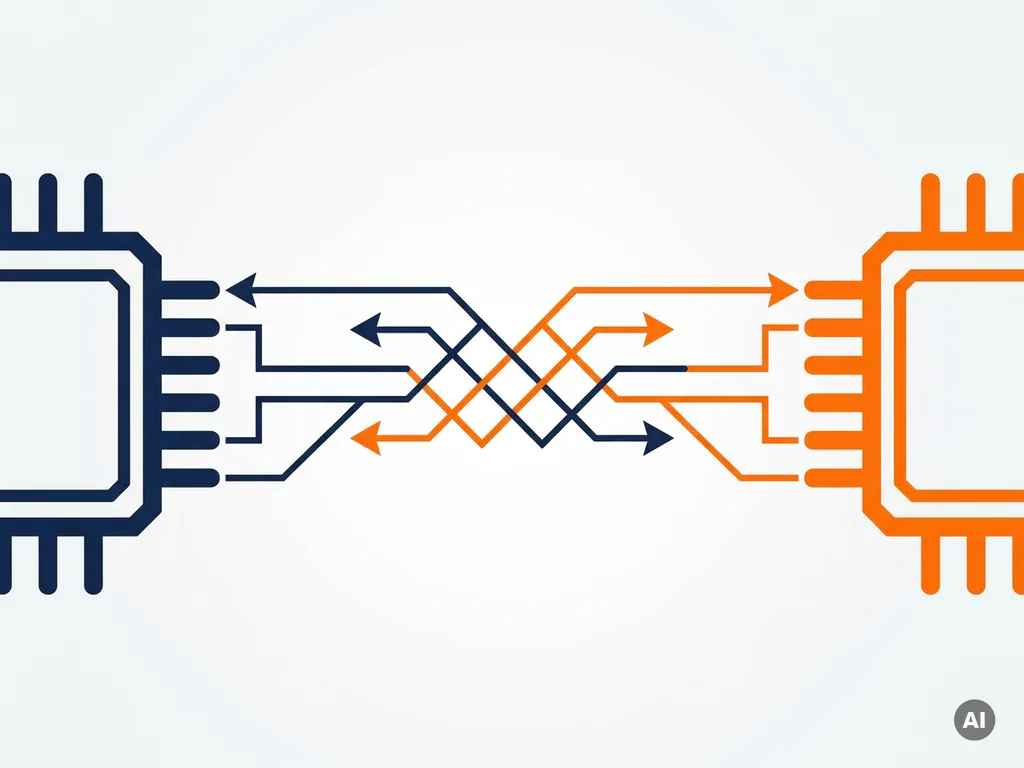
For most enterprise server deployments in 2026, AMD EPYC offers a stronger price-to-performance ratio and higher core counts, while Intel Xeon delivers advantages in specific workloads, ecosystem maturity, and compatibility with legacy infrastructure. The right choice depends on your workload profile, budget, and existing IT environment. This article breaks down the key differences across architecture, performance, cost, and workload fit to help you make an informed decision.
What are the core architectural differences between Intel Xeon and AMD EPYC?
Intel Xeon and AMD EPYC use fundamentally different design philosophies. AMD EPYC uses a chiplet-based architecture, where multiple processor dies are connected via AMD’s Infinity Fabric interconnect. Intel Xeon relies on a monolithic die design for most of its lineup, though newer generations incorporate tile-based designs. These architectural choices affect core counts, memory bandwidth, and I/O capacity in meaningful ways.
AMD’s chiplet approach allows EPYC processors to scale to very high core counts, with current generations offering up to 96 cores per socket. This design also enables significantly more PCIe lanes and memory channels per socket compared to Intel Xeon, which translates directly into better throughput for data-intensive workloads.
Intel Xeon’s monolithic design historically offered lower inter-core latency, which benefits workloads that require tight communication between cores. Intel also integrates features like built-in accelerators for AI inference, cryptography, and data compression into specific Xeon SKUs, which can reduce the need for additional hardware in certain deployments.
How do Intel Xeon and AMD EPYC compare in raw performance?
In raw throughput benchmarks, AMD EPYC consistently outperforms Intel Xeon in multi-threaded workloads, largely due to its higher core counts and greater memory bandwidth. Intel Xeon holds an advantage in single-threaded performance and in workloads optimized for Intel’s instruction set extensions such as AVX-512.
For compute-heavy tasks like scientific modeling, rendering, or large-scale data analytics, EPYC’s core density delivers measurable throughput gains. In database workloads that depend on fast memory access, EPYC’s eight-channel memory architecture per socket also provides an edge over Xeon’s six-channel configuration in comparable tiers.
Intel Xeon performs particularly well in workloads that rely on low latency between cores or that have been specifically tuned for Intel platforms. Applications built around Intel’s oneAPI ecosystem or optimized for AVX-512 can show strong performance on Xeon that does not always translate directly to EPYC systems.
Which processor offers better total cost of ownership for enterprise servers?
AMD EPYC typically offers a lower total cost of ownership for enterprise servers. EPYC processors deliver more cores and memory bandwidth per dollar than comparable Xeon SKUs, which means you can often achieve the same workload capacity with fewer sockets or lower-tier hardware. This reduces both acquisition cost and ongoing power consumption.
Power efficiency is a significant factor in total cost of ownership over a multi-year server lifecycle. EPYC’s performance-per-watt ratio has been competitive with or better than Xeon across recent generations, which reduces electricity and cooling costs in large deployments.
That said, Intel Xeon can offer a cost advantage in specific scenarios. If your organization already runs software licenses tied to per-socket or per-core pricing, a Xeon configuration with fewer cores may lower software licensing costs even if the hardware itself is more expensive. Always calculate your full stack costs, including software, support, and energy, before comparing processor prices alone.
What workloads are best suited to Intel Xeon versus AMD EPYC?
The workload fit between Intel Xeon and AMD EPYC is not a matter of one being universally better. Each processor family has a clear home territory where it delivers the most value.
Workloads where AMD EPYC excels
- High-performance computing (HPC) and scientific simulations that benefit from high core counts
- Virtualization platforms where more cores per socket means more virtual machines per host
- In-memory databases such as SAP HANA, where memory bandwidth and capacity matter most
- Cloud and hyperscale workloads requiring maximum throughput at scale
- Big data analytics with parallel processing requirements
Workloads where Intel Xeon excels
- Enterprise applications with Intel-optimized software, including certain ERP and database platforms
- AI inference workloads using Intel’s integrated accelerators and oneDNN libraries
- Latency-sensitive applications that benefit from lower inter-core communication overhead
- Legacy enterprise environments where existing infrastructure, drivers, and certifications are built around Intel
- Workloads with per-core software licensing, where fewer cores at high frequency are preferable
Should enterprises choose Intel Xeon or AMD EPYC for new server deployments?
For new server deployments in 2026, AMD EPYC is the stronger default choice for most enterprises, particularly those running virtualization, cloud infrastructure, or data-intensive workloads. Intel Xeon remains the better option when your software stack is deeply optimized for Intel, when per-core licensing costs favor fewer high-frequency cores, or when you are expanding an existing Intel-based environment.
Before making a decision, evaluate these factors:
- Your primary workload type: Multi-threaded and memory-intensive workloads favor EPYC; latency-sensitive and Intel-optimized workloads favor Xeon.
- Software licensing model: Per-core licensing can significantly change the cost equation.
- Existing infrastructure: Compatibility with current management tools, firmware, and vendor support agreements matters.
- Total cost over the server lifecycle: Include power, cooling, software, and support in your comparison, not just hardware price.
- Vendor ecosystem: Both platforms are supported by major OEMs, but specific server models and configurations vary.
A mixed strategy is also worth considering. Some enterprises run EPYC-based servers for virtualization and analytics workloads while maintaining Xeon-based systems for legacy applications that require Intel compatibility. This approach lets you optimize each layer of your infrastructure independently.
How Easy Hardware Trading helps with enterprise server processors
Whether you are building a new server environment or refreshing existing infrastructure, finding the right processors for your exact requirements is where we can make a real difference. At Easy Hardware Trading, we work with an international supplier network to source Intel Xeon and AMD EPYC processors to match your specific needs — whether you need a precise manufacturer part number, a discontinued SKU, a bulk quantity, or a component that is simply difficult to find through standard channels.
Here is what we offer to support your server procurement decisions:
- Customer-driven sourcing — bring us your hardware requirements, including exact part numbers, required quantities, and delivery timelines, and our team will actively explore sourcing possibilities on your behalf
- Hard-to-find and discontinued components — our international supplier relationships allow us to pursue components that are no longer readily available through conventional distributors
- Competitive quotations tailored to your specific order, whether you are procuring a single unit or fulfilling a large-scale rollout
- IT asset buyback if you are replacing existing Xeon or EPYC systems and want to recover residual value
- Certified data wiping and logistics for secure, compliant hardware transitions
- Multilingual support from our international sales team across 12 languages
Ready to find the right server processors for your environment? Browse our hardware catalog to see available Intel Xeon and AMD EPYC stock, sell your current hardware to offset upgrade costs, or contact our team directly with your requirements and we will work to find the right solution for your infrastructure.