
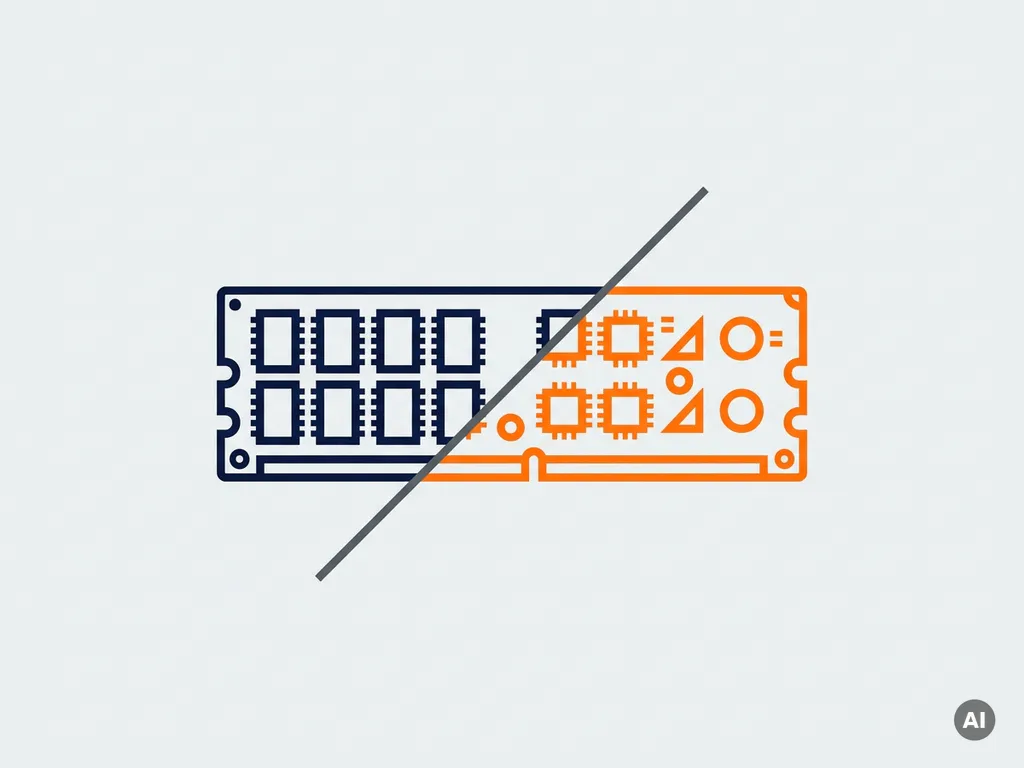
Registered ECC memory (RDIMM) and unbuffered ECC memory (UDIMM ECC) both detect and correct single-bit memory errors, but they differ in how they handle the electrical load between the memory module and the memory controller. Registered ECC adds a register chip between the DRAM chips and the controller, which buffers command and address signals. This makes RDIMMs more stable at high capacities but introduces a small latency penalty compared to unbuffered ECC modules. The sections below answer the most common questions about these two server memory types side by side.
Which servers and workstations use registered ECC memory?
Registered ECC memory is used in multi-socket servers and high-capacity workstations where stability and scalability matter more than raw latency. Platforms built around Intel Xeon Scalable processors, AMD EPYC, and AMD Threadripper Pro all require RDIMMs. Consumer-grade or single-socket workstation platforms typically do not support registered modules.
In practice, you will find RDIMMs in rack servers from the Dell PowerEdge, HPE ProLiant, and Lenovo ThinkSystem lines, as well as in high-end workstations designed for data science, rendering, or virtualization workloads. The reason is straightforward: these platforms need to support large amounts of RAM, often 512 GB or more per socket, and the register chip makes that possible without overloading the memory controller.
Unbuffered ECC memory, by contrast, is common in single-socket workstations and NAS devices. AMD Ryzen Pro and Intel Xeon E-series platforms support UDIMM ECC, making it a practical choice for professional desktops that need error correction without the overhead of a full server platform.
What does the register chip in registered ECC memory actually do?
The register chip in an RDIMM acts as an intermediary between the memory controller and the DRAM chips on the module. It receives command and address signals from the controller, buffers them, and then re-drives them to the DRAM chips one clock cycle later. This reduces the electrical load on the memory controller, which is what allows systems to support more DIMMs per channel.
Without this buffering, the memory controller must drive all DRAM chips directly. Each additional DIMM adds more capacitance to the bus, and beyond a certain point the signal integrity degrades. The register chip solves this by acting as a repeater, keeping signals clean even when multiple DIMMs are installed per channel.
The one trade-off is a single clock cycle of additional latency on command and address signals. This does not affect data transfer bandwidth significantly, but it does mean registered memory has slightly higher access latency than unbuffered memory running at the same speed rating.
Is unbuffered ECC memory faster than registered ECC?
Unbuffered ECC memory has marginally lower latency than registered ECC at the same speed rating because it skips the one-cycle buffering delay introduced by the register chip. In real-world workloads, however, the difference is rarely measurable and almost never affects application performance.
The latency gap between UDIMM ECC and RDIMM is typically one clock cycle on the command and address path. At DDR5-4800, one cycle translates to a fraction of a nanosecond. For most server and workstation workloads, memory bandwidth and capacity matter far more than this marginal latency difference.
Where unbuffered ECC does have a genuine speed advantage is in single-DIMM-per-channel configurations with lower total memory capacity. If you are building a workstation with two or four modules and your platform supports UDIMM ECC, you will get slightly snappier memory access. But as soon as you need more than two DIMMs per channel, registered memory becomes the only viable option regardless of the latency comparison.
Can registered and unbuffered ECC modules be mixed in the same system?
No. Registered and unbuffered ECC memory modules cannot be mixed in the same system. The memory controller must be configured to operate in either registered or unbuffered mode, and mixing module types will prevent the system from booting or cause immediate instability.
This is a hard platform-level restriction, not a BIOS setting you can override. The signaling requirements, timing expectations, and electrical characteristics of RDIMMs and UDIMMs are fundamentally different. Even if both modules share the same DDR generation and speed rating, the controller cannot negotiate between them.
The same rule applies to LRDIMMs (load-reduced DIMMs), which are a third category sometimes confused with RDIMMs. LRDIMMs use a more advanced buffer chip that also isolates the data lines, not just the command and address lines. You cannot mix LRDIMMs with RDIMMs or UDIMMs either. Always verify your platform’s supported memory type before purchasing modules.
What are the cost differences between registered and unbuffered ECC RAM?
Registered ECC memory is generally more expensive than unbuffered ECC memory at the same capacity and speed. The register chip adds manufacturing cost, and RDIMMs are produced primarily for the server market where reliability requirements are higher. The best approach for any deployment is to request a tailored quotation based on your exact specifications, required quantities, and delivery requirements.
A few practical points to keep in mind:
- UDIMM ECC modules are produced in larger volumes for the prosumer and workstation market, which generally keeps them more accessible for smaller deployments.
- RDIMM modules carry a premium because of the added register chip and because server-grade components are certified to tighter tolerances.
- Refurbished RDIMMs from enterprise decommissions are a viable option for budget-conscious B2B buyers, and sourcing these through a specialist supplier with international reach can make a meaningful difference in availability.
- Higher capacities (64 GB, 128 GB per DIMM) are almost exclusively available as RDIMMs, so at those densities there is no unbuffered alternative to compare against.
If your platform supports UDIMM ECC and your capacity requirements are modest, that route is worth exploring. If your server platform requires RDIMMs, working with a supplier that can source specific manufacturer part numbers across international markets is the most reliable way to meet your requirements.
Should you choose registered or unbuffered ECC for a new server build?
The choice between registered and unbuffered ECC memory is determined almost entirely by your platform, not by personal preference. If you are building on a multi-socket server platform or a high-capacity single-socket server, you need registered ECC memory. If you are building a single-socket workstation or NAS with a platform that supports UDIMM ECC, unbuffered ECC is the right and often more practical choice.
Use this as a quick decision guide:
- Multi-socket server (Intel Xeon Scalable, AMD EPYC): Always use RDIMMs.
- High-capacity single-socket server needing more than 2 DIMMs per channel: Use RDIMMs.
- Professional workstation on AMD Ryzen Pro or Intel Xeon E: Check the QVL, but UDIMM ECC is often supported and preferred.
- NAS or storage server with ECC support: UDIMM ECC is typically the correct choice.
- Virtualization host needing maximum RAM capacity: RDIMMs are the better fit for scalability.
Always consult the motherboard or server platform’s qualified vendor list (QVL) before purchasing. The QVL confirms which specific module types, speeds, and capacities are validated for that platform. Buying outside the QVL risks compatibility issues even if the module type appears correct on paper.
How Easy Hardware Trading helps with server memory
Finding the right ECC memory for your specific platform and deployment requirements is where Easy Hardware Trading adds real value. Rather than limiting customers to a fixed catalog, we work with an international supplier network to source registered and unbuffered ECC memory based on what you actually need — whether that means exact manufacturer part numbers, hard-to-find or discontinued modules, bulk quantities, or specific delivery timelines. Here is what sets us apart:
- Customer-driven sourcing — bring us your hardware requirements, including part numbers, quantities, and compatibility constraints, and our team will actively explore sourcing possibilities across our global supplier network.
- Hard-to-find and discontinued components — if a module is no longer in mainstream production, we have the supplier relationships and international reach to track it down.
- Bulk and enterprise orders — whether you need a single replacement module or a full rack deployment, we tailor our approach to your scale and timeline.
- IT asset buyback — if you are replacing existing memory infrastructure, we can help you recover residual value from your old modules.
- Multilingual support team covering 12 languages to help you identify the correct module for your platform and navigate compatibility requirements.
Whether you are buying server memory for a new build or looking to sell surplus RAM from a decommissioned system, we make the process straightforward. Contact us to discuss your requirements and receive a quotation tailored to your platform, quantities, and sourcing needs.