
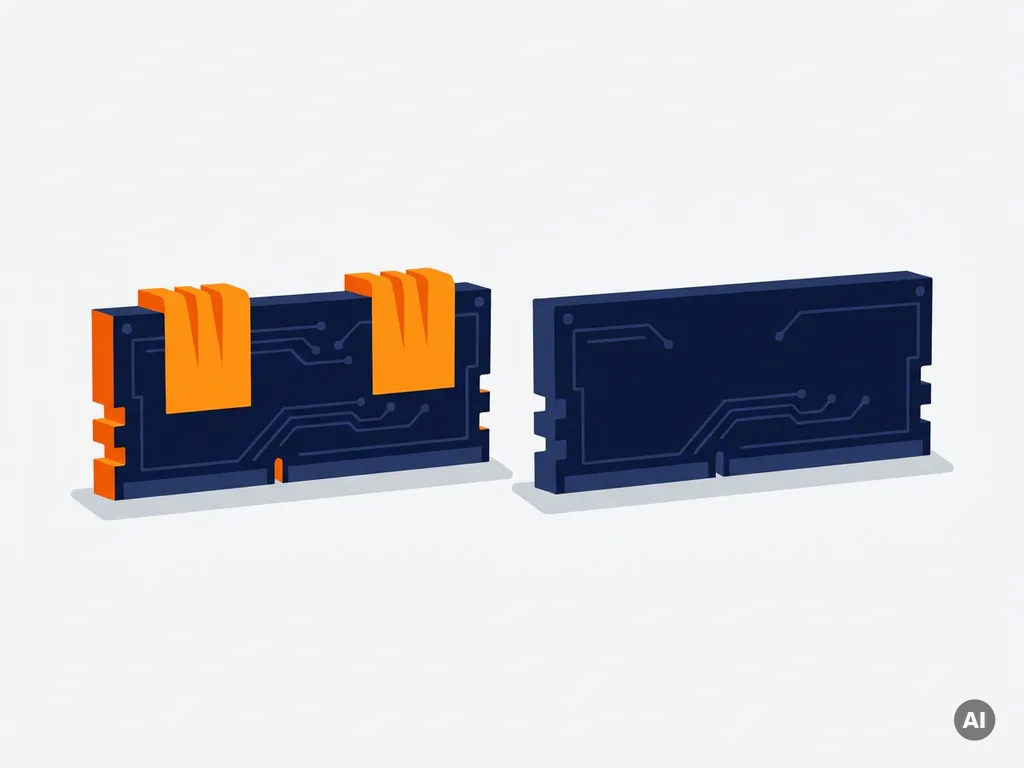
RDIMM (Registered DIMM) and LRDIMM (Load-Reduced DIMM) are both buffered server memory modules, but they differ in how much of the electrical load they offload from the memory controller. RDIMM uses a register to buffer only the command and address signals, while LRDIMM adds a memory buffer that isolates the data lines as well, allowing more DIMM slots to be populated without overloading the controller. The sections below answer the most common technical and purchasing questions about these two memory types side by side.
Which server workloads benefit most from LRDIMM?
LRDIMM delivers the most value in workloads that demand large memory footprints across many DIMM slots. Because the memory buffer reduces the electrical load per channel, servers can be populated with more modules at higher capacities without hitting controller limits. This makes LRDIMM the better choice for memory-intensive applications.
Workloads that benefit most from LRDIMM include:
- In-memory databases such as SAP HANA or Redis, where the entire dataset must fit in RAM
- Virtualization hosts running many virtual machines simultaneously, each requiring dedicated memory allocation
- Big data analytics platforms that process large datasets in real time
- High-performance computing (HPC) jobs that require maximum memory bandwidth across all channels
- AI and machine learning training tasks where model size exceeds what RDIMM configurations can provide
If your server runs general-purpose workloads with modest memory requirements, LRDIMM’s advantages are less pronounced. The real benefit appears when you need to fill eight or more DIMM slots per channel at high capacities.
How does the memory buffer work differently in RDIMM and LRDIMM?
In an RDIMM, a register chip sits between the memory controller and the DRAM chips, buffering only the command and address signals. The data lines remain unbuffered, meaning the memory controller still drives all the DRAM chips on the data path directly. This limits how many DIMMs can be installed per channel before the electrical load becomes too high.
In an LRDIMM, a memory buffer (iMB) buffers the command, address, and data signals. The controller communicates only with the buffer, and the buffer then drives the individual DRAM chips. From the controller’s perspective, the entire DIMM looks like a single load regardless of how many DRAM chips are physically present.
This architectural difference has two practical consequences. First, LRDIMM allows higher memory density per server because more DIMMs can be installed per channel. Second, the buffer introduces a small amount of additional latency because every data transaction passes through an extra chip before reaching the DRAM.
Does LRDIMM always have higher latency than RDIMM?
LRDIMM typically has slightly higher latency than RDIMM at low memory populations, but the gap narrows or effectively disappears when both configurations are fully loaded. When a server runs only one or two DIMMs per channel, RDIMM has a measurable latency advantage because there is no buffer overhead. As the number of DIMMs per channel increases, RDIMM performance degrades due to signal integrity issues, while LRDIMM maintains stable performance.
In practice, the latency difference between the two types is measured in nanoseconds and rarely affects real-world application performance in a noticeable way. For latency-sensitive workloads such as low-latency trading systems or real-time transaction processing, the choice of processor, storage, and network configuration has a far greater impact than the difference between RDIMM and LRDIMM.
It is also worth noting that DDR5 LRDIMM designs have reduced the latency gap compared to earlier DDR4 generations, making the trade-off less significant in modern server builds.
Are RDIMM and LRDIMM physically interchangeable in a server?
No, RDIMM and LRDIMM modules are not interchangeable, even though they use the same physical slot and connector. The two types use different signaling protocols, and a server’s memory controller must be specifically configured to work with one type or the other. Mixing RDIMM and LRDIMM modules in the same server is not supported and will cause boot failures or system instability.
Before purchasing server memory, always verify the following:
- Check the server’s official qualified vendor list (QVL) or hardware compatibility list (HCL)
- Confirm whether the CPU and motherboard support LRDIMM, RDIMM, or both
- Match the DDR generation (DDR4 or DDR5) and speed rating to what the platform supports
- Verify that all installed DIMMs in a server are of the same type
Some server platforms support only RDIMM, some support only LRDIMM, and a smaller number support both. Always consult the server documentation before ordering replacement or expansion memory.
When should a business choose RDIMM over LRDIMM?
A business should choose RDIMM when the server workload does not require maximum memory density and when lower latency or lower cost per module matters more than total capacity. RDIMM is the right choice for the majority of standard enterprise workloads, including web servers, file servers, mail servers, and moderate virtualization environments.
Specific scenarios where RDIMM is the better fit:
- The server will run with two DIMMs per channel or fewer
- Total memory capacity requirements stay below what RDIMM configurations can comfortably support
- The server platform does not support LRDIMM
- Budget constraints make the lower cost of RDIMM modules important
- Workloads are latency-sensitive and memory capacity is not a bottleneck
For most SME deployments and mid-range servers, RDIMM provides an excellent balance of performance, compatibility, and cost. LRDIMM becomes relevant primarily when you are scaling memory to the limits of what a platform supports.
What is the price difference between RDIMM and LRDIMM?
LRDIMM modules are generally more expensive than equivalent RDIMM modules because of the additional memory buffer chip and the more complex manufacturing process. The exact difference varies by capacity, speed, generation, and supplier, so the most reliable approach is to request a tailored quote based on your specific platform and quantity requirements.
However, comparing price per module can be misleading. The more useful comparison is cost per gigabyte of usable memory at a given server configuration. Because LRDIMM allows higher total memory capacity in the same server, the cost per gigabyte can be competitive when you account for the fact that RDIMM configurations may require an additional server to achieve the same total memory pool.
When evaluating the total cost of a memory upgrade, consider:
- The number of DIMM slots available in the server
- The maximum supported capacity per slot for each memory type
- Whether the workload actually needs the additional capacity LRDIMM provides
- The availability of refurbished or pre-owned LRDIMM modules, which can reduce upfront costs
Refurbished RDIMM and LRDIMM modules from reputable suppliers offer a practical way to manage costs, particularly for businesses upgrading existing infrastructure rather than buying new.
How Easy Hardware Trading helps with server memory upgrades
Choosing between RDIMM and LRDIMM is only part of the challenge. Finding compatible, quality-tested modules in the right quantity, at the right specification, and within your delivery timeline is where many businesses lose time and budget. We help you solve that directly.
At Easy Hardware Trading, we offer:
- Customer-driven sourcing — bring us your exact manufacturer part numbers, required quantities, or delivery requirements, and our team will use its international supplier network to explore every available sourcing option
- Hard-to-find and discontinued components — we go the extra mile to locate specific RDIMM and LRDIMM modules across DDR4 and DDR5 generations, including items that are no longer in standard distribution
- Bulk and project-based orders — whether you need a single replacement module or a full rack upgrade, we tailor our approach to the scale and urgency of your requirement
- Compatibility verification — our multilingual sales team works with you to confirm that every module matches your specific server platform before you commit to an order
- IT asset buyback services if you want to sell your existing memory when upgrading to a higher-capacity configuration
Whether you are looking to buy server RAM for a new deployment or need help sourcing a specific part that has proven difficult to find elsewhere, we are ready to help. Contact us with your hardware requirements and we will work with you to find the right solution for your infrastructure.