
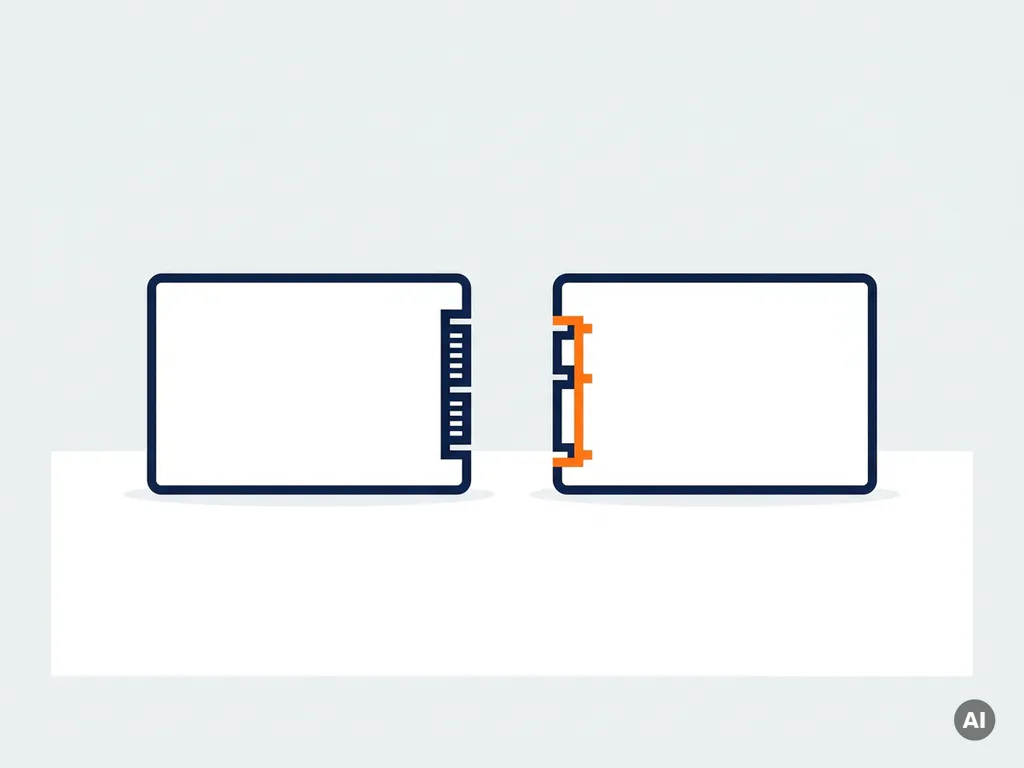
SAS SSDs and SATA SSDs are both solid-state drives, but they use different interface protocols that affect speed, reliability, and cost. SAS (Serial Attached SCSI) drives are built for enterprise environments that demand high throughput, dual-port redundancy, and heavy concurrent workloads. SATA (Serial ATA) drives offer strong performance at a lower price point, making them a practical choice for lighter server workloads and cost-sensitive deployments. The sections below break down the key differences so you can match the right drive type to your infrastructure needs.
Which workloads actually need SAS SSDs over SATA SSDs?
SAS SSDs are the right choice for workloads that combine high I/O demand, continuous operation, and a need for fault tolerance. Database servers, virtualization hosts, high-frequency transaction systems, and storage arrays with multiple simultaneous users all benefit from SAS. The dual-port design means the drive stays accessible even if one path fails, which matters when downtime carries a real cost.
Specifically, consider SAS SSDs when your environment includes:
- Mission-critical databases that run 24/7 and cannot tolerate I/O bottlenecks
- Virtualization platforms serving many virtual machines from a single storage pool
- High-frequency trading or financial systems where latency spikes are unacceptable
- Enterprise SAN or NAS arrays designed around SAS backplanes
- Workloads with mixed read/write patterns that saturate SATA bandwidth limits
If your server runs a single application with predictable, moderate I/O, a SATA SSD will handle it without the added cost of SAS.
How does SAS SSD speed compare to SATA SSD speed?
SAS SSDs are faster than SATA SSDs, particularly in write throughput and random I/O operations. SATA is capped at roughly 600 MB/s due to the interface specification, while SAS 12Gb/s can reach up to 1,200 MB/s. In real-world server environments, that gap becomes most visible under sustained mixed workloads rather than simple sequential reads.
Sequential throughput
For large sequential transfers, such as backup streams or bulk data movement, SATA SSDs perform well and often reach close to the interface ceiling. SAS SSDs pull ahead when the workload stays heavy for extended periods, because the SAS protocol handles command queuing more efficiently under sustained pressure.
Random I/O and latency
Random read and write operations are where SAS SSDs demonstrate a clear advantage. Enterprise SAS drives support deeper command queues and more efficient error recovery, which reduces latency under load. For database engines that generate thousands of small random I/O requests per second, this difference is measurable and meaningful.
Are SAS SSDs and SATA SSDs physically compatible?
SAS SSDs and SATA SSDs are not directly interchangeable in most cases. A SATA SSD can physically fit into a SAS backplane on many enterprise servers, because SAS controllers are backward compatible with SATA devices. However, a SAS SSD cannot be used in a SATA-only controller, as SATA does not support the SAS protocol.
In practice, this means:
- A server with a SAS HBA or RAID controller can accept both SAS and SATA SSDs
- A server or workstation with a SATA-only controller will not recognize a SAS SSD
- Mixing SAS and SATA drives in the same RAID group is generally not recommended, as it can limit performance to the slower drive type
Always verify your server’s backplane and controller specifications before purchasing drives. The form factor (2.5-inch or 3.5-inch) and the connector type are separate considerations from the interface protocol.
Why are SAS SSDs more expensive than SATA SSDs?
SAS SSDs cost more than SATA SSDs because they include enterprise-grade components, dual-port connectivity, and more sophisticated firmware designed for continuous heavy use. The SAS interface itself adds hardware complexity, and SAS drives are produced in lower volumes than consumer or prosumer SATA drives, which keeps unit costs higher.
The price premium reflects several concrete factors:
- Dual-port architecture: Two independent data paths require additional hardware and increase manufacturing cost
- Higher endurance ratings: SAS SSDs typically carry higher drive writes per day (DWPD) specifications, meaning the NAND and controller are built to handle more write cycles before wear-out
- Enterprise firmware: Advanced error correction, power-loss protection, and end-to-end data integrity features add development and component cost
- Lower production volumes: SAS is a server-specific market; SATA benefits from massive consumer and commercial PC production scale
For many deployments, the higher cost is justified by the longer service life and the reduced risk of unplanned downtime.
When should a business choose SATA SSDs instead of SAS?
A business should choose SATA SSDs when the workload does not require the additional throughput, redundancy, or endurance that SAS provides, and when budget is a meaningful constraint. SATA SSDs deliver strong performance for a wide range of server applications and represent excellent value when the SAS premium is not warranted.
SATA SSDs are a practical fit for:
- Web servers and content delivery with predominantly read-heavy, moderate-traffic workloads
- Development and test environments where performance headroom is not the priority
- Small business file servers with a limited number of concurrent users
- Boot drives in servers where the operating system is the only workload on the drive
- Archival or cold storage tiers where data is written infrequently
If your server uses a SATA-only controller or your storage budget is tight, SATA SSDs let you move from spinning hard drives to solid-state storage without the full cost of a SAS upgrade.
What is the future of SAS and SATA SSDs in enterprise storage?
Both SAS and SATA SSDs are mature technologies that are gradually being supplemented by NVMe in new enterprise deployments. NVMe drives, which connect via PCIe rather than SAS or SATA, offer significantly lower latency and higher throughput. However, SAS and SATA SSDs remain widely deployed and will continue to serve existing infrastructure for years to come.
In 2026, the practical outlook is as follows:
- SAS SSDs remain the standard in legacy enterprise SAN environments and will continue to be sourced and supported for existing arrays
- SATA SSDs are still widely available and cost-effective for servers that do not support NVMe
- NVMe is the growth direction for new server builds, but it requires compatible controllers and backplanes that many existing servers lack
- Refurbished SAS and SATA SSDs offer a cost-effective way to extend the life of existing infrastructure without a full platform migration
For businesses managing mixed-generation server fleets, SAS and SATA SSDs remain relevant and practical choices, particularly when sourced through a partner with the reach and flexibility to fulfill specific requirements.
How Easy Hardware Trading helps you choose the right enterprise SSD
Choosing between a SAS SSD and a SATA SSD depends on your server platform, workload intensity, and budget. We work with businesses that have specific hardware requirements — whether that means an exact manufacturer part number, a discontinued model, a large bulk order, or a hard-to-find component that standard distributors no longer stock. Our team speaks 12 languages and works with customers across the globe, using an international supplier network to explore every sourcing possibility on your behalf.
Here is what we offer to support your server storage decisions:
- Customer-driven sourcing of SAS SSDs and SATA SSDs for enterprise servers and storage arrays, including discontinued and hard-to-find models
- Exact part number matching to ensure full compatibility with your existing backplane, controller, and storage array
- Flexible order quantities, from single replacement drives to large-scale bulk procurement
- Competitive quotations tailored to your specific requirements, sourced through a worldwide supplier network
- IT asset buyback if you are replacing older drives and want to recover residual value
- Certified data wiping to handle decommissioned storage drives securely
Whether you want to buy enterprise SSDs for your next deployment or sell your used drives as part of a hardware refresh, Easy Hardware Trading gives you a reliable, internationally oriented partner for the full IT asset lifecycle. Contact us with your storage requirements and we will put our sourcing network to work to find the right solution for you.